
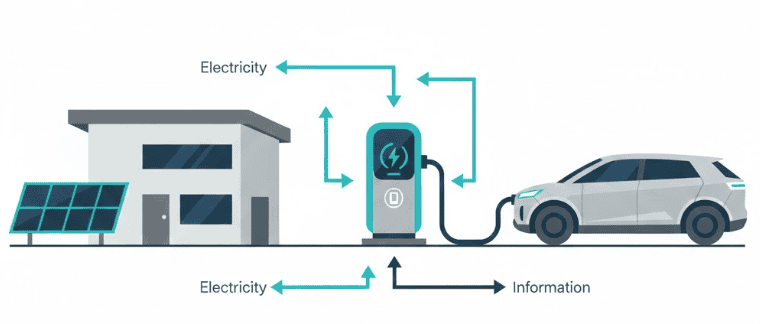
We’ve all seen the marketing: a sleek Ford F-150 Lightning powering a cabin in the woods during a storm. It’s a compelling vision. Using that massive 100kWh battery sitting in your driveway to run your fridge and AC seems like a no-brainer compared to a noisy, gas-chugging generator.
But as a homeowner, moving from “cool concept” to “flicking the switch” involves more than just a long charging cable. If you’re considering Vehicle-to-Home (V2H), here is the unvarnished reality of what it takes to turn your EV into a backup power plant.
1. The “Compatibility” Bottleneck
The biggest hurdle isn’t the technology—it’s the handshake. Just because your car has a big battery doesn’t mean it can “talk” back to your house.
The Hardware Standard: Most EVs currently use the CCS (Combined Charging System) or NACS (Tesla) standards, which were originally designed to take power, not give it. While the Nissan Leaf (using the older CHAdeMO standard) has done this for years, newer models like the Chevy Silverado EV and Ford F-150 Lightning require specific, often expensive, proprietary home integration kits.
The Software Lock: Even if the hardware is capable, many manufacturers haven’t unlocked bidirectional features yet. Tip: Always check if a firmware update is required before buying home hardware.
2. The Hidden Costs of “Integration”
The blogosphere often quotes the price of the bidirectional charger (usually $3,000–$5,000), but the hidden “ouch” is the labor.
To run your home safely, you need a Home Integration System (HIS). This includes an automatic transfer switch (similar to what a Generos/Tesla Powerwall uses) to “air-gap” your home from the grid. Why? Because if your car sends power back into a “dead” grid while a utility worker is fixing a line, it can be fatal. Expect the total bill—charger, parts, and a specialized electrician—to land between $8,000 and $12,000.
3. The “State of Charge” Anxiety
In a traditional backup scenario (like a Tesla Powerwall), your battery is always at 100%, waiting for a disaster. With V2H, your battery is also your transportation.
There is a real-world balancing act here:
The Commuter’s Dilemma: If you come home with 15% battery after a long day and the power goes out immediately, your “home backup” is effectively useless.
The Depth of Discharge: To protect the longevity of your EV battery, you should rarely drain it to 0%. Most V2H systems allow you to set a “floor” (e.g., stop discharging at 20%) so you aren’t stranded in an emergency.
4. Efficiency Losses: The 15% Tax
Powering a home with a car isn’t 100% efficient. You lose energy converting DC (battery) to AC (home) and back again. Most systems see a 10-15% round-trip loss. If you pull 10kWh from your car, you might only get 8.5kWh of actual usable light and heat. It’s still cheaper than a gas generator, but it’s something to factor into your “days of backup” math.
5. Will it Void Your Warranty?
This is the “elephant in the room.” Some manufacturers are still vague about whether frequent V2H cycling counts against your battery warranty. While the Ford Lightning and certain Hyundai/Kia models explicitly support it, always read the fine print. Using your car as a “grid stabilizer” for daily peak-shaving is much harder on the chemistry than using it for the occasional emergency blackout.
The Verdict: Is it worth it?
V2H is a win if:
You live in an area with a “shaky” grid and frequent 4-8 hour outages.
You are already buying a high-capacity EV that supports bidirectional flow.
You want a “silent” backup solution that doesn’t require storing stabilized gasoline.
Wait on it if:
You’re looking for a quick ROI (Return on Investment). The setup costs are currently too high to be “paid back” by energy savings alone.
You have a short-range EV or a very long daily commute.
What’s your next move? Before buying any hardware, call your local utility company. Some offer massive rebates for bidirectional-ready homes, while others have strict “anti-islanding” rules that might make your installation more complex.
While V2H is a game-changer, its biggest flaw is simple: it leaves with you when you drive. To achieve true energy independence, many homeowners are pairing their EV with the Lithtech Energy Storage Series. Whether it’s the Stacked Series for easy capacity expansion, the Wall-mounted units for a sleek, space-saving footprint, or the Rack-mounted modules for heavy-duty integration, Lithtech provides the “always-on” foundation your home needs. By using Lithtech for daily peak-shaving and essential backup, you ensure your lights stay on even when your car is at the office, making it the perfect partner for a bidirectional charging setup.
